
Linda Kerth
Posted January 13, 2026
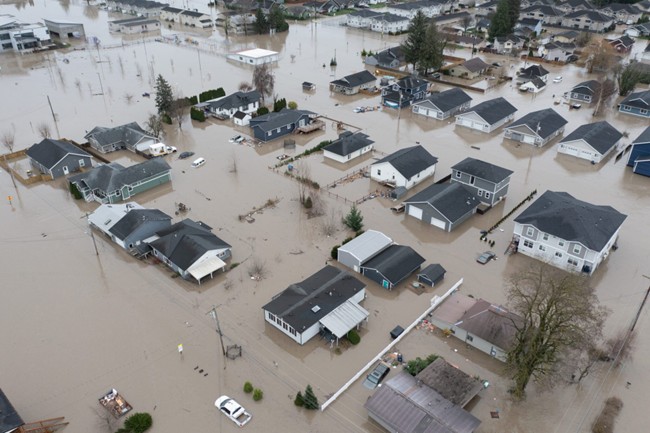
December 17, 2025: More rain today. After at least 10 days of continuing rain, with only short breaks in between. Yesterday there was a high wind warning as well. There are literally rivers of rain hitting the Northwest Coast, coming all the way from Hawaii. One after another atmospheric rivers, at least five, so far. Small towns like Sumas (right on the Canadian border), Everson and Nooksack are still recovering from equally bad flooding the occurred in 2021.
Now residents are watching their homes fall into the North Fork of the Nooksack River, which has become a raging tumble of water moving downstream. In Peaceful Valley, where I live, the temperature is 40oF with an 86% chance of rain. At least here there is high ground and no flooding. There was a brief break this morning, and we actually saw the sun for a few hours. Blessed sun! Last night the power was out for over four hours.
You might ask, what are atmospheric rivers? Caused by cyclones, they are long, narrow plumes of moisture transported by winds from the tropics. Described as rivers in the sky, a couple dozen of these thin ribbons of humid air reach the Pacific West Coast every winter, and when the moisture is lifted by hills and mountains, cause flash floods and landslides. Each carries as much water as the Amazon River!
What We’re Facing
According to a recent NASA-led study, climate change is likely to intensify extreme weather events such as atmospheric rivers. The study’s lead author, Duane Waliser, of NASA’s Jet Propulsion Laboratory in Pasadena, California pointed out:
“The results project that in a scenario where greenhouse gas emissions continue at the current rate, there will be about 10 percent fewer atmospheric rivers globally by the end of the 21st century….. the atmospheric rivers will be, on average, about 25 percent wider and longer, the global frequency of atmospheric river conditions — like heavy rain and strong winds — will actually increase by about 50 percent.” (https://science.nasa.gov/earth/climate-change/climate-change-may-lead-to-bigger-atmospheric-rivers/)
In mid-December, the Cascadia Daily News reported: “Rain, snow, landslides, high winds: We’re not yet out of the woods.” Rivers could remain in flood stage until January 20, 2026, more than a month later!
Two to three feet of snow were predicted over Mount Baker, our local quiescent volcano. A blizzard warning was issued for the mountain areas. Nearly 700 households sought support in Whatcom County. Low-lying farms have been devastated, and most are not insured (only buildings are insured, not farmlands).
In Whatcom County, the Nooksack River at North Cedarville remained under watch. It was expected to crest at 144 feet at 10 a.m. December 17, while in Ferndale the Nooksack would hit 15.86 feet at 10 p.m. The weather service also warned of increased threats of landslides. Rain puts more pressure on soil instability, especially in recent burn areas and on steep hill sides. There were already multiple slides across the state, including at Kendall, the nearest small town to me.
Damage for city facilities in Everson alone was said to be estimated at $2-3 million, which doesn’t include flooded private homes.
According to meteorologists, an unusually persistent bulge in the jet stream since late November acted like an atmospheric conveyor belt, directing moisture-laden air from the South Pacific directly into the Cascades. This inundated the mountains with 200% of their average rainfall in the 30 days before December 17, keeping temperatures above freezing. This matters when it comes to the mountains, because snow levels are higher than usual, above 5,000 feet.
When areas normally protected by snowpack have instead received rain, ,the Cascade Mountain’s’steep terrain funnels rain into the region’s numerous smaller rivers, which eventually fill the larger rivers, like the Nooksack. This hits already deluged low-lying communities with a one-two punch.


Leave a Reply