
Report on Week 5 of Solidarity’s reading and discussion series, “125 Years of Socialist Strategy in the US Labor Movement”
BY IVAN DRURY ZARIN
“The foundations of socialism were born centuries before Marx,” Paul Ortiz said in his introduction to our class on the roles of race and anti-racism in socialist labor strategies. “What came out of Black and Latinx self activity in the US, Latin America, and Africa, those were the essential components of socialism: mutual aid, worker control over the conditions of labor, the right to strike, cultural activities that aimed at making work more humane and more survivable.”
Ortiz explained that race has been fundamental to the organization of class society in the US. “By 1891 racism was already a fundamental part of capitalism,” he said. “Racism as an ideology has been used to justify oppression in a multiplicity of workplaces. Racism is used to justify war. To justify laws like Jim Crow and Juan Crow that subordinate groups of workers to lower wages and worse working conditions. Racism was a tool used to transform the US into a nation of slave catchers. And today, to justify the slaughter of people in Palestine.”
For Ortiz, race is as fundamental to capitalism’s social organization of production as it is to working class self-organization. He said, “racism is a reactionary response to working class struggle,” and workers’ anti-racist struggles are the highest articulation of class consciousness and worker self activity.
These fundamentals framed the discussion in the fifth class of Solidarity’s series on socialist strategies in the labor movement. From this basis, Ortiz discussed contemporary meanings of intersectionality and racial capitalism in the context of the Trumpist uses of race in its reactionary campaigns.
We mistakenly did not record the first few minutes of Paul Ortiz’s presentation, but we did get most of it, and it is well worth listening to, alongside the readings for the week. You can listen to it here, and watch a video of it here.
Principles of intersectionality and racial capitalism
I was curious about Paul Ortiz’s use of intersectionality and racial capitalism, two terms that have been challenged recently by Marxists in the academy. Discounting the complaints from class reductionist Marxists and economistic social democrats, I’ve read revolutionary socialists critique intersectionality as inadequately methodological; that it softens the edges of class critique and blurs problems of class struggle protagonism by substituting categories (and quantities) of oppression for strategies of leadership and unity against capitalist domination. This has undoubtably been the case when liberals have appropriated intersectionality language and critique. Racial capitalism has been similarly critiqued by revolutionary socialists as inadequately and inconsistently theorized.
Ortiz spoke briefly to these critiques, saying that some Marxist colleagues complain that intersectionality and racial capitalism are liberal terms. He tells them that he these are the frameworks he’s seen adopted by the most radical social movements today. He said, “The movement today is characterized by its intersectionality. For example, the activists I meet today from the Black Lives Matter movement are mobilizing against ICE.” These frameworks, which I think he deploys more like principles than methods, are clearly driving forces in his historical thinking.
In the small group I was part of, Folko M said, “what Ortiz referred to as intersectionality, I think is cross racial solidarity.” And if his intersectionality is a principle of socialist strategy and action, then his racial capitalism is his principle of historical and social study: a first-principle starting point; a category of analysis.
Taking intersectionality as an activist principle and racial capitalism as a principled starting point resolves a lot of the problems raised by trying to torque these ideas as method. What’s the difference between a method and a principle? A philosophical method divines general rules for analysis, which are useful for solving all sorts of problems; they are broadly applicable through adjustment for specific conditions. In the Grundrisse, Marx describes his philosophical method as “summing up” the “concrete” historical conditions around a phenomenon. He writes, “The concrete is concrete because it is a synthesis of many determinations, thus a unity of the diverse. In thinking, it therefore appears as a process of summing-up, as a result, not as a starting point, although it is the real starting point, and thus also the starting point of perception and conception.” I find this method applicable to historical and sociological study, as well as in developing strategies to fight capitalism through class struggle.
Principles are more conditioned by historical, social problems and the specific relations of forces in a particular moment. We might have a lot of principles, but the ones that we use most actively and consciously are those that are most activated — by their usefulness in our political advance or defence. When the 2020 mass movement for Black lives advanced anti-racist action, racial capitalism and intersectionality were useful articulations to experiment with while we attacked white supremacy. Both liberals and socialists used these ideas, each to their own ends, and often in competition. Now that Trumpist reactionaries are attacking the gains of the Black freedom and migrant justice struggles, liberals are less interested in these principles, but, as Ortiz argued, they’re all the more important for socialists to pick up and wield.
During the discussion in this class, Ortiz said, “In higher education now, we’re not asked to look at anti-Black or anti-Latino discrimination at all. That’s an effect of these attacks on Black studies.” This repression in universities is an aspect of the broad social attack on communities of color, just as the anti-racist programs Trump is attacking were part of the revolt of working class communities of color. “Look where all these programs came from,” he said. “From third world solidarity! Labor studies where I teach now came from the postwar labor revolt.”
“We are in this stage where state and capital are using really refined forms of racism to divide us,” he said. “We have to rebuild these coalitions to make sure no one feels left behind. If there’s anti-semitism in a workplace then it has to be shut down. And when people are organizing to stop genocide in Palestine, they are the ones really under attack.”
Ortiz argued that because race organizes class exploitation, “When we fight against racism today, defending our neighbours, we are doing the work of socialism.”
Racist reaction
Paul Ortiz’s book Black and Latinx History of the United States is a catalogue of the racial-social organization of capitalism in the US. In the chapter we read for this class, Ortiz argues that “Capital employed a dual-wages system… to divide and conquer the working class,” paying white workers a premium that produced a material basis for what historian George Lipsitz called a “possessive investment in whiteness.”
In his presentation he elaborated the continuity of that dynamic up to today. He said, “Today race is organized also through citizenship. But this is not new. There are long histories that have framed race through citizenship: that Mexican and Latinx workers are not suitable for citizenship or for specific jobs. That Mexican workers cannot handle machines.” The racialization of jobs also “justified laws like Jim Crow and Juan Crow that subordinated groups of workers to lower wages and worse working conditions.”
This formulation goes beyond the cliched statement that capitalists use racism to divide workers; a claim that I’ve always found to be too close to conspiracy theory. Race and gender organize class socially, into the bodies in which working class people live (to paraphrase the much-cited expression from Stuart Hall), but not by some illuminati puppet string. Workers swim crosswise in the currents of capital, reaching for what flotsam floats. As Dubois argues in Black Reconstruction, the availability of a solution to a poor white man’s misery matters more than its political correctness, even if that most available solution is an illusory trap.
The political contest between racist, exclusionary border governance, and what Ortiz called anti-racist, “emancipatory internationalism” is therefore predominately practical and practiced. “Socialism is when we do real world social activities,” he said. “A lot of our movement is involved in offering real support during these ICE assaults. People in my community stand guard outside migrant churches. We provide grocery delivery.” These mutual aid activities are political resistance to Trump’s assaults and also imaginative practices that redraw socialist political horizons.
In defence of insurgent history
In this struggle against Trumpist nativism, fields of interpretation are also important battlegrounds. Ortiz said, “The US government is waging an attack on history. Black and women’s history and labor history is being shut down, not because these classes are unpopular. Young people want to take these classes. They’re being shut down because the US government is shutting them down. One of the most important things we can do is keep these histories alive. But the war on history is not on all history. We’re supposed to bow down to Alexander Hamilton. There was just a big show on the US’s greatest banker. But the only thing that has kept Black studies or Latinx studies alive in Florida is collective bargaining.” Trumpists are mining histories of immigration regulation to reanimate laws and apply bygone techniques to expel and terrorize migrants and political radicals today while attacking teachers, schools, and university departments that tell insurgent histories.
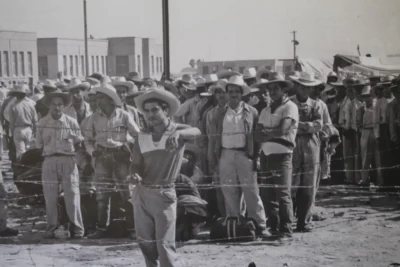
One example Ortiz discussed was the 1929 Immigration Act, which effected a terror against migrant communities, pressuring them to “self-deport.” He said, “This is something that affected my own family. The 1929 Crash was blamed on Mexican people. It was referred to as Mexican repatriation, and businesses treated it as Mexican management. Mexican workers near the border, even US citizens, were rounded up and deported to be readmitted under bosses control. Mexican repatriation is a tragic period in US history. Today, when we had the economic meltdown, the state also blames Mexicans and other migrants for this crisis.”
This example demonstrates the plasticity of Ortiz’s general claim that “racism is a reaction to working class struggles.” Capitalism does not like working class struggle because it threatens the capitalist’s control over production, makes the conditions of production more unstable and unpredictable, and presses back against the capitalist drive to increase the portion of the working day that workers surrender to surplus labor time and surplus value creation. Other factors can also cause crises on at least two of these fronts, and the capitalist may reach for that same racist tool to solve crises that are not directly caused by autonomous worker activism.
During the years of Trumpism, state-capitalist racism has responded to constricting labor markets by manipulating migrant entries, through terror against racialized migrant communities in the US and through mass international student deportations in Canada. We can also interpret racist attacks on university programs as a tip of the spear of a top-down reorganization of professional classes, a disinvestment in public education, and a deskilling of intellectual labor.
Ortiz’s histories prove that racism has been a reactionary response to working class struggle. Racism is also a reactionary response to other theatres of capitalist crisis and social reorganization; a social axis upon which the capitalist state can lever reactionary social reforms.