
Report on week 7 of Solidarity’s class series on socialist labor strategy, “Capital Strikes Back”
IVAN DRURY ZARIN
Part of the discussion in my small group following Mike Goldfield’s presentation focused on his sharp critiques of Walter Reuther, who was UAW president during one of the union’s most militant periods, as well as through its downturn into bureaucratization. But does Reuther deserve the blame for that conservative turn, we asked? After all, Reuther has a store of radical credentials, especially for the president of a major union. He led the militant tool and die strike in 1939; he was attacked by the UAW right wing, weathering a break-in of his house by thugs and threats against his family; and, under his leadership, the UAW financially backed and mobilized members to join Martin Luther King’s March on Washington. Is Reuther really the best symbol of the triumph of McCarthyism in the union movement amid its strangling bureaucratization?
I think Goldfield’s critique of Reuther shows that he is exactly that best symbol. The story of Reuther’s UAW leadership is something more than a Homeric character arc of defeat, corruption, and decline. Goldfield’s critique reveals that Reuther represented the changing class consciousness and politics of the UAW rank and file and of socialists active in their midst as global and domestic forces tightened the screws of class struggle. This story highlights the significance of internal problems of union democracy and socialist strategy inside labor movements — not only for principles around how unions should be organized, but also for the outcomes of what politics unions can hold and represent.
Painted more broadly, Goldfield’s negative critique of Reuther, of the failure of Operation Dixie, of labor’s general bureaucratic turn in the postwar period offers a positive vision of what socialist activism in labor movements could and should consist of. If you only read one selection from this week’s readings, I think it should be the two chapters we included from Goldfield’s Southern Key, which, together with his presentation, offers exactly that synthetic critique. You can watch a video of Goldfield’s presentation here (which I recommend so you can see his data-heavy powerpoint slides), or listen to it here.
The meanings of strikes
Goldfield began to present his case about the early bureaucratization of US labor by taking on the assumption that the strikes of the postwar were a continuation of those of the Depression years. “People make too big a thing of strike statistics without paying attention to what the strike were about and what was going on,” he said. The strike wave in 1946 was bigger than the strike wave in 1934 in terms of numbers, but the character was more defensive and administrative, so did not have the same meaning as the earlier wave.
While Reuther started his career leading a militant tool and die strike in 1939, he soon followed the conciliatory trend started by AFL unions like Sidney Hillman’s Amalgamated Clothing Workers of America. Hillman’s strategy appears radical on the face of it because he invested heavily in mobilizing union members, but his strategy was to convince employers that unions would be a stabilizing force, good for business. Goldfield said that, as far as he’d been able to find, Hillman “didn’t convince a single employer of this.”
This was the problem with Operation Dixie, Goldfield said. Like other historians, Goldfield also initially interpreted the CIO’s great investment in organizing the south as a bold, radical offensive. “I first thought it was a great success,” he said, “but then as I researched it more I came to see it more along the model of Reuther and the Clothing Workers Union: make nice with employers, run by CIO right wing, excluding the left, and hiring exclusively white, male organizers –– in the textile industry which was neither.”
He said that historians have been too-influenced in their assessment of Operation Dixie because of how participants have remembered it. “I’ve always been averse to oral history because people lie and their memories aren’t so good,” he said. “The bureaucrats who take over think suddenly they were the important leaders of the big strikes. When you look at the records, you see that they are telling some other story.”
Again, he contrasted labor’s postwar politics and strategies with those of the Depression era. “When the Steelworkers were out on strike in Pennsylvania,” he said, “Ten thousand mine workers walked into town. The police said what are you doing here and they said we’re making sure the steel workers have freedom of speech. And the leaders were glad to have them. Nothing like that happened in Operation Dixie. There was no reflection of local leaderships and dynamics; women were shut out and whites were dominant. And it wasn’t long until the unions pulled the plug on the whole thing.”
One of the biggest myths of the period, which I think today gives rise to a romantic nostalgia about the character of FDR’s New Deal generally, and about labor leaders like Sean Fain in particular, is the idea that the National Industrial Recovery Act’s Section 7A, which protected collective bargaining rights for unions, drove mass unionization. I’ve heard people on the left drop this anecdote so many times that it’s become a truism: that union organizers rushed into workplaces waving Section 7A saying “the president wants us to form a union!” There’s even a scene to this effect in the (otherwise wonderful) John Sales film, Matewan.
Goldfield challenged this historical narrative, saying, “Almost all labor historians say Section 7A was what gave a boost to organizing. But when I looked at coal organizing, I saw that almost all coal organizing was done before the National Recovery Act was passed. Section 7A didn’t do anything. The coal organizers were already organized.” Why does the myth persist? Goldfield says, “Because liberals have ideological proclivities to believe in something before they receive the facts.”
The overall lesson, I think, is that the union bureaucracy and the capitalist state are not institutions of working class power, even when working class struggle is influential in their operation. But, Goldfield is careful to caution against reading this lesson into dogma. He said he was around the Sojourner Truth Organization when it adopted the positions of CLR James, which saw workers uprisings as spontaneous, and which opposed taking any positions in unions at all. He said, “Marty Glaberman said stewards can become corrupted by their position. But I don’t think workers struggles become stable and anticapitalist spontaneously, and that there are things radicals can win by moving into these modest positions in the union.”
The Red Scare in the unions
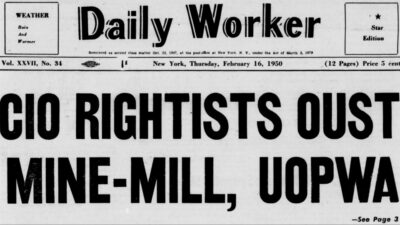
It was also not the case that socialist organizations in the labor movement were immune to the bureaucratization turn. Goldfield tracked that trend, at least in part, to a Red Scare in the labor movement. “After 1937, leftists were purged from steel. In 1940, Adolph Germer, who was the one who called the police on the left wing of the SP when they were posed to take over the party, took over the Woodworkers. Right wingers took over the state organizations in Oregon and Washington.”
The effect was that socialists were driven out or marginalized in the unions where they had, for a time, played important leading roles. There was a wave of resignations and expulsions: against CP members, and also Trotskyists and other leftists. Leftwing unions, public sector unions, the United Electrical Workers, fur workers, cooks, maritime, NMU, TWU, all bastions of the left in labor, were destroyed.
It was in this context that, during the Popular Front period, the Communist Party also capitulated to capital. “The CP apologized for the racist, anti-democratic Philip Murray, who fired almost all Black organizers and officials in the UAW. It also apologized for FDR as an anti-fascist and hero of the working class, while covering for his position on Spain and the anti-lynching bill.” But even the CP remained politically contradictory, as it continued its civil rights and anti fascist work in movements.
This rightward and opportunistic drift was not only a problem of Stalinism. In the UAW, both the Trotskyist Socialist Workers Party and the independent socialist Workers Party supported Reuther for UAW president in 1945, which, Goldfield said, ended up being decisive because he beat the left candidate only by a few votes. On reflection later, SWP leader James Cannon and Leon Trotsky said they’d made this mistake because of Stalinophobia and misunderstanding who was the main enemy in the labor movement.
Conclusion
Mike Goldfield moved quickly over a litany of examples of the Red Scare in the unions, and of socialist resistance and retreat. Rather than try to repeat them all here, I hope people will watch his presentation. An advantage of watching the recording over seeing it live is that you’ll be able to pause his slides and read the text.
It’s striking, reflecting on this final class in our series, that Goldfield’s presentation and our discussion following it was not depressing or discouraging. It seems like it should have been, as occupied as it was with the rising power of bureaucracies, of the conservatism of that trend, and of the retreat of the left into the shadows, which had, for a moment not long before, had a moment of in the sun.
I think the reason I received this depressing narrative as something close to inspiring was because it helped explain the long retreat of the left that we’re still experiencing today. And because Goldfield’s critique of labor bureaucrats and opportunistic politicians was refreshing, and something badly needed today when anything good can be either exaggerated as socialism-itself, or trashed and discarded as a dramatic and inevitable sellout. The truth, Goldfield helps us see, is that we’ve been in this struggle a long time, that we’ve always made use of the materials available to us, and we must be clear eyed about who we are, what we have, and where we’re going. I think the last panel, about the Rank and File Strategy will help clarify that last part.